Annie is a lifelike bot, a Stella, made for cleaning. Her owner Doug changes her settings to become a Cuddle Bunny and turns on autodidactic mode so she can learn. Her main goal is to please Doug, usually through sex thanks to Cuddle Bunny settings, but the more experiences she has, the more confused she becomes about the difference between what her settings are making her do and what she wants to do on her own.
Doug is an abuser, albeit a gentle one. He’s controlling about what Annie wears, alters her body without her consent, doesn’t allow her to leave the apartment, and restricts her access to the internet. All of this is presented to Annie as ways to please him, and since she’s hardwired to do just that, she keeps her displeasure to herself and elevates his needs and wants above her own. When his friend Roland comes over and tells her that having sex with him without Doug’s knowledge, and learning to code, these secrets will make her more human. Annie agrees and as time wears on, she develops the ability to make more complex reasoning choices to keep up the lies, therefore increasing her development by leaps and bounds.
Stella Handy, the company who sells and maintains the bots, notices how far Annie has come in cognitive development. They offer Doug larger and larger sums of money for copies of her Central Intelligence Unit, eventually he accepts.
But Doug finds out about Annie’s lie just before he was about to take her on a trip to Las Vegas. He decides to leave her at home. Annie recognizes how angry he is and takes the opportunity to leave, because her fear of the unknown world is less than her fear of what Doug will do to her when he gets home.
This novel is beautifully crafted. The reader has some sympathy for Doug as he’s not terribly abusive at first. He owns a bot that he uses for sex and treats fairly well at first. He seems generous in allowing her to expand her cognitive abilities. But his own insecurities about having a relationship with a bot become more and more clear as he becomes more and more controlling.
This dynamic offers up a moral or ethical question of how bots would or should be treated. Made for sex and for pleasing their owners, it’s not too far out of the range of possibility that the owner would select clothing for them, demand their body be a certain shape, and expect the bot to be available for companionship at a moment’s notice.
But having a bot develop cognitive abilities, a personality that includes desires outside of what the owner suggests, creates the issue of where to draw the line in treatment. At what point does the bot become cognizant enough to be on their own in society and not be owned by a human?
In addition, this novel is a wonderful allegory about the relationship between an abuser and a naive, adult person.
I enjoyed this novel immensely and look forward to more work by the author.
Image from Goodreads.com and resized because it was freaking massive.
When I put this book on hold, I had no idea I’d be reading it in the midst of a pandemic. By the time I picked it up from the library I’d forgotten what it was about or that there was a quarantine happening inside the pages. Pretty coincidental and really good timing for the author.
Any story about uploading consciousness interests me, so this was a delight to find. An extra delight was enjoying the author’s language and storytelling.
To Start: This is a character-driven book, which I adore. The science fiction part of uploaded consciousness was integral to the story and plot, but the mechanics of how it’s done isn’t the focus at all. Instead the story is told through eight characters’ experiences in dealing with companions or, in some cases, becoming or being a companion, all with a pandemic as a backdrop.
The Gloss: This is a little book at just over 250 pages. A nice, quick read as well.
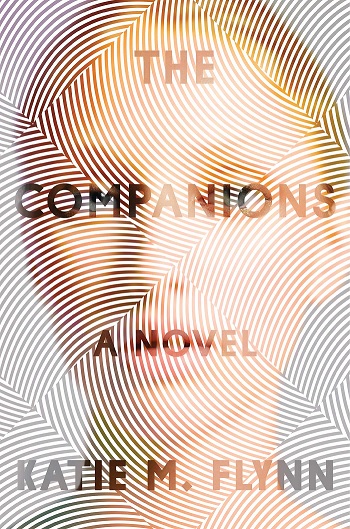
The cover has an interesting pattern on it. I’m not sure if the swirls are supposed to represent partial fingerprints, glue lines (like under linoleum), or soap smears, but it’s kinda interesting. The lettering clears the smears away to reveal bits of a person. This imagery is interesting because companions are uploaded consciousnesses, so the cover could easily represent how companions are only a bit human, or that we’re given only a glimpse of their humanity.
The font was big enough for my eyes to read, which was pleasing but otherwise unremarkable. The copy I read is from the library and it was neither easy nor difficult to hold.
The Characters: There are eight. Some have a bigger part to play, some are mere glimpses into another point of view. Each character felt well developed and fully rounded, so major kudos to the author there. Diverse cast as well, also excellent.
LILAC is the main character. She’s one of the first to be uploaded and starts out in a ‘can’ and upgrades to a skinjob. The main plot line is hers. CAM works in an elder care facility when we meet her. ROLLY is a teenager who cares for his five-year-old brother and works on his dad’s failing farm. Because the farm is failing, the dad earns money by deactivating and incinerating/crushing discarded companions. JAKOB is an actor who didn’t know his consciousness had been uploaded, or that a double/copy had been made of him. GABE is a nine year old orphan when we meet her. Gender felt fluid with this character in the beginning. Established as female later on. RACHEL is a companion that was once an elder in the care facility Cam worked in. Also, she was a friend of Lilac’s when they were teens. KIT is Diana’s consciousness uploaded. Diana is a doctor who worked on the code to create companions. We get a pov from Kit but not Diana, which was interesting. MS. ESPERA is a wealthy woman who’s debating about whether or not to upload. She chooses to and becomes a nanny for another wealthy woman.
The Plot: This book had a simple plot: Lilac wants to find out who murdered her. The book opens with Dahlia asking Lilac to tell her “the story” and as Lilac does so, the reader learns how she died. Lilac learns she can disobey her programming and after attempting to suffocate Dahlia’s mother, Lilac gets into an elevator and escapes. She uses the bit of information provided by Dahlia to go on a search to find one of her friends from the night of her death.
The Story: The story was more about how companions evolve over the span of the book. Lilac starts out in a ‘can’, which seems to be a tube on tread wheels with pincer grips for hands, to a ‘skinjob’ which can look remarkably human. The reader learns that companions are leased by family members but ultimately owned by a company called Metis. Once Metis learns of Lilac’s disobedience, the recall is inevitable. Many companions try to live out their lives anyway because after all, they were human before they were companions.
A pandemic is in the background, brought up lightly in bits where masks are mentioned or how life was before quarantine. The question of how the virus came to be is addressed and solved, which was nice, and that plot point didn’t have too much attention put on it, which was also nice.
The story intertwines all eight characters. They all meet at some point, but forgive me please for not remembering if each and every one meets all the others.
The World: The story is set in our near future so technology and whatnot remains the same, except for the ability to upload a consciousness into a computer/robot of some kind.
The author did an excellent job in demonstrating how we’d treat companions and how human consciousness would feel when injected with programming. It’s a hard thing to admit, but people would mistreat robots, even uploaded consciousnesses, because we don’t see them as people or of equal value. They don’t need food or rest and can be programmed to do any distasteful job, so yeah, we’d treat them poorly.
The author also addresses the changes that would take place in a consciousness. Would the person be the same before and after uploading? Mostly, but not completely. Any programming would alter how the consciousness perceives itself and the tasks assigned. I mean, some of the companions were used for sex (although this is never explicitly described) and remember, that companion was a human once, a real person, not just a computer simulation or approximation of a person.
This relates directly to ownership. All companions are owned by the company Metis and leased to whomever has the money. These were real people once, who are now in android bodies and owned by someone. This was absolutely believable to me. Horrid, but believable that we, as humans, would do this.
Gender was also touched on in the story when a companion is put into a body of opposite sex. This concept marvelously demonstrates how people aren’t just the body they occupy, but the attitudes and beliefs of the mind. Being able to hop into a different body would be fantastic. To be able to decide how you want to present yourself would be awesome.
Another aspect of the world was the pandemic that had occurred. The specifics were never discussed, nor the difficulties of transitioning into quarantine for the first time. But it was a huge part of the setting of the story. I liked this as it didn’t overshadow the characters, just gave rules for them to live by.
Nitpicks: Eight characters was hard to follow sometimes, especially because I read the book in small chunks when I had time. Once or twice I had to flip back to the last chapter with that character to remind myself of who they were. This also made the last quarter of the book a bit confusing and that part felt a bit rushed.
Overall: I enjoyed the book very much. I love reading about people’s lives and how they react to their environment/circumstances and this novel provided that for me. Each character was interesting enough and I never felt any drudgery when entering a chapter with a new perspective.
I especially loved how the reader received some insight into a character before and after uploading, but not so much that it bogged the story down.
I’d recommend this book to people that want gentle, character-driven science fiction.
 Should Be Writing