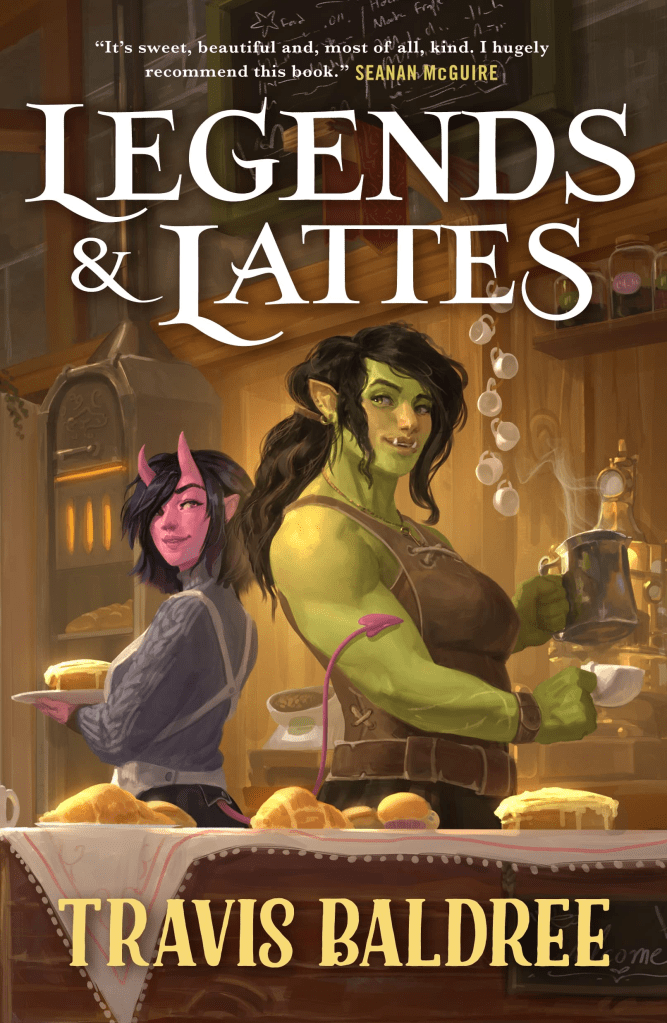
Fern, a rattkin, is dissatisfied with her life so she moves to Thule to be closer to her friend Viv. Viv helps her set up a bookshop right next to her coffee shop Legends & Lattes and Fern is successful, yet still feels discontent. In a drunken moment, she decides to hide under a tarp in an elf’s cart rather than talk to Viv about her dissatisfaction. The trundling cart wakens Fern and begins an adventure, alongside an elf and goblin, that she never dreamed could happen.
I admit, I was expecting this novel to feature Viv even though the cover art and inside flap description told me something different. As usual, I opened the novel without reading the flap (to see if I could sus out the plot and characters) so I was disappointed to find this story about a rattkin instead.
Once I let go of my expectations, I enjoyed the journey of the novel. Fern is sensible and delightful and her adventures are realistic, fun, and just enough tension to keep me turning the pages. The ending is neatly tied up with a delightful twist about the bounty on the goblin, but still left things open for a sequel involving the same characters.
While the author’s first novel felt too sparse on description, and the second novel just the perfect amount of description, I felt this novel inserted description in a way that took away from the story instead of adding to it. This novel felt wordier, somehow, without being as rich as the previous one. The plot in this one felt a bit too stretched out as well, with a lot of dithering from Fern in between stops on the journey. Having said that, I did enjoy it enough to hope the author continues the series.
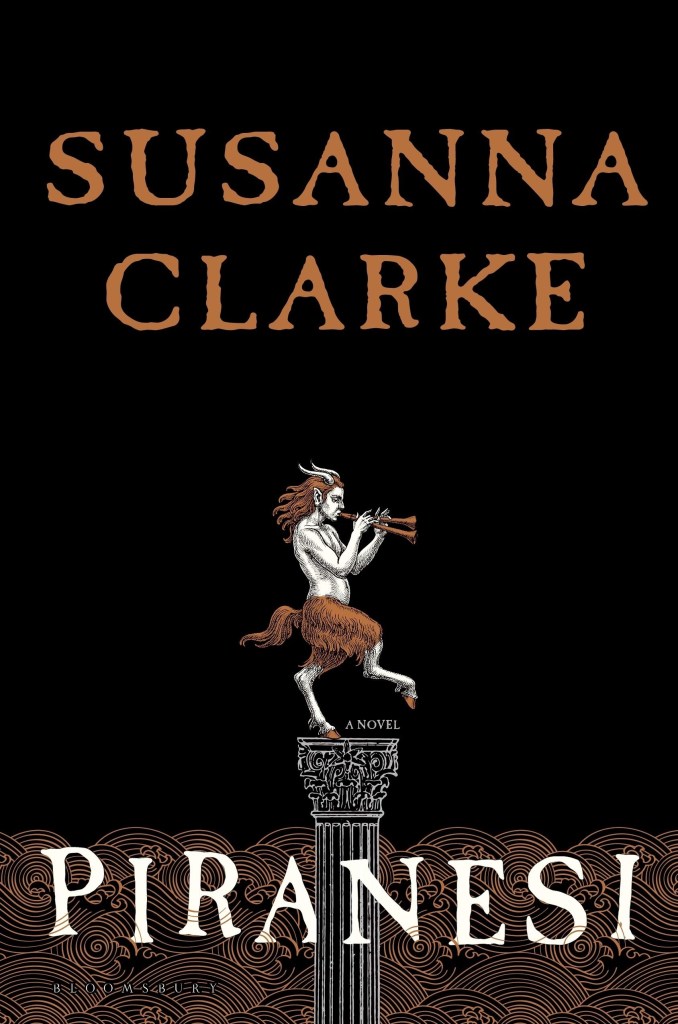
Piranesi lives in a house where the ocean laps at the bottom level and the sky fills the top. An endless labyrinth, the house is filled with statues, birds, and even fish in some water-filled rooms. Piranesi keeps a meticulous journal of the goings-on of the house, including his bi-weekly visits with The Other, a person who named Piranesi but refuses to offer a name of himself, and a mysterious person, named 16, lurking the halls. The Other tells Piranesi that talking to 16 will make him go mad, but curiosity gets the better of Piranesi and while investigating 16, Piranesi unravels the true reason he’s living in the house.
I was engrossed in the novel immediately. Piranesi’s personality shines through the pages; his kindness for the human skeletons in the house and his resourcefulness in finding food, maintaining a clean habitat, and mending fishing nets. The Other has given him gifts of shoes and whatnot, which immediately clued me in that The Other can leave but somehow Piranesi cannot, nor does he want to. He’s confused but is content with his confusion.
That is, until 16 turns out to be a gentle person who has been looking for him. She tells him of his family and friends and how he’s been missing for six years. Piranesi has no memory of any of this, but understands that staying in the house means being alone, and so he leaves with her.
The house is like a dimension that can be accessed if the person chooses to see it. The Other shows Piranesi how to get there but not how to return.
Engaging novel, overall. Definitely different from mass market stuff, definitely one that will stick with me.
Grace is a woman in her seventies who is stuck in a rut. Once upon a time she was a wife and mother but lost both her husband and son, now she fills her days with the same routine, slowly fading into the background of life.
When she receives a letter informing her that she’d been left a property in Ibiza, Spain, she decides she might as well check it out. While she hadn’t seen the owner of the property, Christina, in decades, nor had she been close to Christina, the mystery of why this college friend would leave her a house was enough to disrupt her usual pattern of her day.
Grace has no idea that her entire world will be upended in the best possible way, nor that the simple act of diving could infuse her with life.
The author weaves a tale of supernatural abilities, kindness, grief, loneliness, and joy against a lively and vivid backdrop of Ibiza. The novel is told as a letter to a student, who reached out in a time of need, and is glorious in its complexity. Grace is a delightful character, one who softens as the pages go on, and who opens up to life’s experiences despite being attached to her grief.
The novel was one I’d love to relive, to experience again for the first time. Its tone is soft, its characters vivid, and the message of respect delightful.
This novel is a prequel to Legends & Lattes, where the reader gets to meet a young Viv who is just starting out in the mercenary business.
Viv is injured during a battle with her mercenary group Rackam’s Ravens and is tucked away in Murk to heal. With limited mobility due to her injury and frustrated at the slow process of healing, Viv sets out to check out Murk. She finds a cluttered bookshop run by a foulmouthed rattkin named Fern, and a bakery run by a dwarf named Maylee. Fern convinces Viv to try reading a book and while Viv is initially skeptical, she ends up devouring the words.
A tiny bit of adventure comes to town in the form of a figure wrapped in grey and smelling of necromancers, a whole lot of skeletons, and a summer fling with Maylee.
This novel could also be labelled “high fantasy, low stakes” like its predecessor. The tension is light, the descriptions are vivid and immersive, and the characters unique and delightful. The author did exactly what I was hoping for after the first novel: bulked up the narration with descriptions to help keep me in the world.
I wanted to live inside these pages. I adore the world that the author has created. The characters are delightful, the plot is simple, and the narrative voice is compelling. I’ll be buying a copy of this book and the previous just so I can revisit them whenever I please.
I don’t normally read a lot of fantasy, but the “high fantasy and low stakes” remark on the back cover caught my attention. I ended up loving this book so much that I wanted to crawl in between the pages and live there. The author’s narrative style was engaging and made for an easy read. My single and only complaint is that some scenes could use a little fleshing out. They felt a bit bare-boned in places and I craved just a tiny bit more padding between bits of action and dialogue.
The author did well in describing the different characters so I had an idea of what a hob or rattkin was despite my lack of fantasy background. I particularly enjoyed how the author presented each species as more than the expected criteria. Like the main character, Viv, is an orc but isn’t bloodthirsty and violent. Although she can and will wield a sword when needed. This was wonderfully refreshing.
There’s the teensiest bit of romance as well. Once Viv settles into running the shop she realizes she has warm feelings for Tandri, a succubus who has been helping with advertising and general management of the shop. These feelings don’t come to light until near the end and the author did a wonderful job in building their relationship so the warmth felt natural.
The stakes are, indeed, low. Viv opens a coffee shop in Thune after living a life slaying beasts and receiving bounty. She gets a hold of a Scalvert’s Stone, which the superstitious believe to have the ability to bring fortune and success. She buries the stone in her new shop and marvels at the wonderful people that come into her life. Cal the hob helps her renovate an old livery, Tandri the succubus helps her with advertising and running the shop, Thimble the rattkin becomes her baker, and a dire-cat comes and goes as she pleases.
Viv worries about the stone often enough that it never leaves the reader’s mind. An old party mate, Fennus, comes around to sniff it out, and the Madrigal’s group of thugs warn of payments needed to keep the peace.
These threats are present, but not the focus. The gentle pace of the novel created a soft world, one of delight and joy, with only enough stress to make the joy seem balanced.
The novel also featured a short story in the back, “Pages to Fill”, which gave some insight into the turning point for Viv. She’s in the midst of a quest when she decides she wants something more from life. More than beating people up, more than hunting down bounties, more than bloodshed. For me, it was like a last sip of the world before I had to let it go.
I recommend this novel to anyone who plays D&D, or perhaps would like a softer tone on monsters and mayhem.
What happens to the children that come back from fantastical worlds? Well, they go to a special boarding school so they can be re-integrated into society.
Nancy is one such girl. Having recently returned from a Land of the Dead, she has no interest in bright colours, sunshine, or living people. Instead, she’d rather be with the Lord of the Dead again.
Except the doorway closed behind her and disappeared when she returned to this world, stranding her here. She, like all the students, wants to go back.
Just as she’s getting a handle on how the school works and that there are others that have visited different worlds, students start turning up dead and missing body parts. Now Nancy and her new friends must find out who is killing them and why.
This is a novella, only 169 pages long, and packs a wonderful punch about belonging, identity, and found family. A delightful read and an interesting take on doorways to other realms.
This book was fantastic, multi-layered, and engrossing. I’m honestly not sure where to begin.
The plot: People are losing their shadows. Without warning and without prejudice, the shadow just detaches and vanishes. When someone’s shadow is lost, they can do magic.
They can re-route roads, create walls of water, put wings on antlers, or make entire areas disappear. But there’s a cost: the loss of memories. The pull of magic is almost too much to resist, so the person will eventually forget what food or water is and perish.
While the book is told from four character’s perspectives, two stood out to me.
The first was Max. She loses her shadow two years after the phenomenon begins and decides to leave her husband, Ory, and the safety of the abandoned hotel they’d been holing up in. She takes her tape recorder with her and dictates her memories. While travelling she meets up with others who are heading to New Orleans, where they’d heard there might be help for the shadowless.
The author did a fantastic job of writing the slow loss of Max’s memory. At first Max doesn’t seem to be forgetting anything, but once her memories are noticeably failing, they degrade rapidly.
The second was The Amnesiac. This is a character who, just before The Forgetting incident, was in a car accident and lost all his memories. Diagnosed with complete retrograde amnesia, he recalls how to speak, what to eat, and whatnot but has no personal memories. While he’s told he loved sailing, it was just data to him, not something where he could feel the salt spray on his face.
He works with a doctor and the very first person to lose their shadow. As The Forgetting progresses, The Amnesiac tries to continue the doctor’s work of searching for a way to re-attach shadows to people. These new shadows don’t hold the memories of the person, though. A shadow of a rock will make a person comatose. A shadow of a book will give false memories.
The Amnesiac is able to use the dictation to create a new shadow, but does that shadow belong where it’s stitched? The author had me guessing right up until the reveal, which was fantastic.
I want to read this again, just to see if I can pick up the clues of the ending sooner. Also because the author’s rich worldbuilding had me engrossed from the first page to the last. Excellent book, and I’m eager to read more by this author.
I loved this book so much that when I was done I wanted to write the entire thing myself. I wanted to marinate in this universe, explore every option, and exhaust every possibility of every life the main character could have lived. There’s even a smattering of envy that the author wrote this instead of me. Why did I like it? Well, let me tell you a little about it first.
Nora Seed is not enjoying life. The book chronicles several disappointments in her life, culminating in the decision to take an overdose. Rather than outright dying, she ends up in a library filled with green books. The librarian resembles a librarian from her childhood, Mrs. Elm, and shows her The Book of Regrets. This book is heavy, as regrets tend to be, and filled with every regret Nora has had from birth to the overdose.
Mrs. Elm tells Nora that she can peek into another life, another Nora, one where the original Nora didn’t have a particular regret. Nora’s first decision is to eliminate the regret of leaving her partner Dan, and opening a pub with him instead. The librarian hands her a book, she starts reading, and pops into the Nora that lived in the timeline where these events occurred.
This concept fascinated me. I’ve spent a fair amount of daydream time considering how much I’d love to travel back in time and redo an event or unmake a decision, or even make a decision rather than sit idly by. The author’s take was that Current Nora would inhabit Other Nora’s body on the same day as it is for Current Nora. So, no going back in the past. Also, Current Nora didn’t have any of the knowledge that Other Nora had. She had no history in this timeline, so a lot was unfamiliar, including her own body, to some degree. But she did retain knowledge of her original life, so she viewed each new life through the lens of her old life.
The longer she stayed in one place, the more memories would come to her. If she felt any disappointment or desire to return to the library, off she went and met up with Mrs. Elm again. If she decided that this was the life she wanted, she would get to stay.
As long as she was in between life and death, she was in the Midnight Library and could access other timelines. As soon as something happened to her original self – like she died or woke up – the library would vanish and she’d go back to her original body or be dead.
Nora explored many options, everything from Olympic swimmer to famous keyboardist/songwriter in a band to a life working with dogs. The more lives she explored, the more she understood that she had no right to take the life away from Other Nora, and that what she thought was a good life was also fraught with negativity. The whole story reminded me of the phrase: if we all put our problems in a pile, we’d each take our own rather than someone else’s if given the choice. Nora got a nice glimpse into many lives, but ultimately knew the best one was her original one, if the overdose doesn’t kill her first.
The book hooked me immediately. I loved the author’s voice, how the choice of words seemed to bring a lot of information while saying relatively little. Each chapter is small, nicely bite-sized, so I never felt bogged down or like I was slogging through, as I sometimes do with long chapters.
I borrowed this book from the library, but I think I’ll go out and purchase it so I can read it again and again. Maybe even write fanfiction about it so I can live in the world a little longer.
I put this book on hold at the library because I read a review that said it was weird and that there was nothing quite like it out there. I’m looking for comparable titles for my own book, so I thought this might fit. It doesn’t, not quite, but it was an amazing read. So amazing that I’d like to buy a copy just to have on hand.
The story starts out normal enough. A person named Carolyn is walking down the road, covered in blood and barefoot. She had just murdered someone but wasn’t ruffled at all. Very quickly, the reader learns that she’s something called a librarian but didn’t start out as one, and that she had vague memories of being American.
Information is doled out in little packets. We learn that her cul-de-sac was hit by something when she was young, the neighbourhood children survived, and became librarians with specialties known as ‘catalogues’. Her catalogue was languages; past, present, imaginary, and real.
The author weaves in dimensional realities in a way that felt natural and, well, right. Not once did I feel lost, not once did I have to go back and reread something to confirm information. I was instantly engrossed in the story of Carolyn and her quest to search for Father, the entity that trains the children on their catalogues. He’s missing, and Carolyn and her siblings cannot access the library to search for him.
Carolyn does more than search for Father. She sets up a series of events so she may murder Father and take over his reign. I was absolutely thrilled that she wasn’t thwarted at all, that she did succeed, that her brothers and sisters were eradicated in this process. It’s a bit of a pet peeve of mine, to read how the protagonist is constantly having to alter the plan and change tactics because of a worthy adversary. Some stories suit this well, but this one had enough going for it that constant threats to her plan would’ve been tiresome. I know that I just gave away the ending, but really, the book is worth reading page by page simply for the experience of existing in this universe.
The author also ensured the reader never forgot the fantastical nature of the world. Carolyn and her siblings never quite dressed according to social norms, their conversational skills were lacking but adequate, and their explanations of events showed how different their world was compared to our world. Really excellent anchoring from the author.
The narrative flow was so excellent, so engrossing for me, that I searched to see if the author has written anything else. Why yes, yes there are other works. Except they’re technical manuals for Linux and whatnot.
Like I said above, the story was revealed in perfect sized bits, and arranged in a manner that made the novel easy to read and follow. I very much want to take each scene apart and reconstruct the book in linear form, but only so I can understand it better and apply it to my own work. The author’s voice makes me want to be a better writer, to make other people read my stuff and feel as electrified and energized as I do from reading this book.
I seriously considered writing fan fiction of this, simply to keep myself engrossed in the world for a little bit longer. I may still do so, but when I have enough energy to focus on more than one thing at a time.
If you’re looking for something different but still realistic enough to keep you grounded, for something so well written that guessing the next step is nigh impossible, read this book. I will be recommending it to everyone whose queries even vaguely apply.





 Should Be Writing