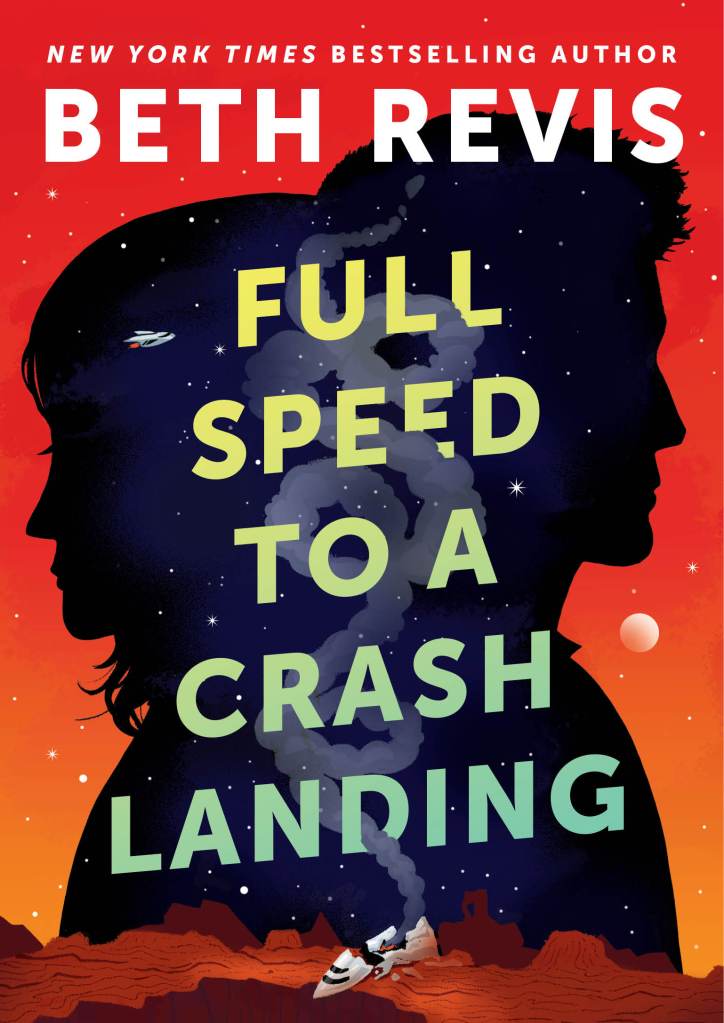
Ada Lamarr is running out of air. She sent a distress signal and knows there’s a huge vessel nearby but they took their sweet time answering. When they finally arrive, she’s barely alive and has to launch herself out of the giant hole in her ship, across empty space, and into her rescuer’s ship. She barely makes it.
Once there, she needs to explain why she was looting a ship that had crash landed on the nearby planet. Lamarr knows what’s on that ship and knows that her rescuer’s ship had no reason to be in the area except to also retrieve something from the downed ship.
What follows is a heist novella, where the author skilfully leaves clues that build to a massive cliffhanger ending.
While this was very well written – Lamarr’s character is vibrant and consistent – it’s frustrating to read a novella that ends so abruptly. The story is complete, yes, but also leaves room for sequels, sort of like Marvel movies and their after-credit scenes that give a taste of a future movie.
Still, the novella immediately gives the stakes and a sense of character and never slows down. It was entertaining enough for me to seek other work by the author.
Note: there’s a page of binary code near the end. I translated it: “This data has been compromised. This d1t1 has bee6 compromised. This data haromised. This data haromised.ised.ised.ised”
Stephen King was the first author to show me what I call a ‘conversation style’ narrative drive. When reading his works I always felt like I was firmly inside the mind of the POV character, and that mind wasn’t a highbrow, highfalutin’ kind of person. Instead the perspective was more Regular Joe, albeit an oddball Regular Joe.
This radically different narrative drive was a refreshing change from what I was reading at the time. I felt like King had opened a door into a different kind of book, a more engaging and richer book, with strange goings-on to boot.
I cut my teeth on Christine, Pet Sematary, Cujo, and Carrie. This length of novels allowed me to really dig in to his characters and feel like I was given a secret door access into their minds. His longer works, like The Stand, drag a bit for me and his shorter works, his novellas, tend to shine in their brevity.
All that said, I purchased If It Bleeds at an airport so I’d have something to do if all my electronic devices failed me on a flight. It turned out none did, so I only got around to reading this book now.
I kept having to re-route my eyes, as they skipped over words and skimmed sentences. This isn’t normal for when I’m reading King. It’s almost like someone else wrote these stories. With that, here’s my impression of the four stories.
Mr. Harrigan’s Phone Craig lives in a small town with his dad. An extraordinarily wealthy man, Mr. Harrigan, moves into a big house on the hill. After hearing Craig recite some Bible passages in church, he hires him to read to him and water his plants.
They develop a kind of friendship. Mr. Harrigan gives Craig scratch-off tickets along with a card a few times a year. When one ticket pays a fair sum of money, Craig buys Mr. Harrigan an iPhone, one of the first iterations of it.
Mr. Harrigan dies and Craig slips the iPhone into his pocket. From there, the story has a King-ish twist, where Craig receives texts from that phone, but only after he calls it to hear his friend’s voice.
This is a story mostly about consequences and settling debts, but it was lacking a bit. The story was fine, the pacing fine, the characters fine, but I thought it was going to go somewhere else. Mr. Harrigan sees the wealth of information and asks the question of when, or who, will stem the flow. I thought the story would go there, but it didn’t, leaving that thread loose.
The story was okay. Not King’s best work, but okay.
The Life of Chuck Don’t we all think we’re the protagonist of our own stories? Or that we contain multitudes? Chuck wasn’t aware of it, but he was what kept the world alive.
This story is told backwards: act three, then act two, then act one. It was an interesting way to see Chuck’s life, what was important to him, and how he learned to let go and dance. Also, a haunted attic.
The story felt a bit forced though. Too many mentions of the scar on Chuck’s hand, maybe. Just trust the reader to be able to figure it out, no need to put so much focus on it. Overall it felt clumsier than I’d associate with King.
If It Bleeds This was the longest story in the collection, one that might push the boundary of novella length, and rather weak.
The story itself is fine. A private eye, Holly, realizes a news anchor could be a creature from her past. The same kind of creature that killed her colleague some years before. She investigates and discovers that she’s indeed correct.
I had three main problems with this story.
The first is that it was a semi-sequel to a novel, The Outsider. I hadn’t read the novel and wasn’t really familiar with the story, but I could pick up the clues: there was a shapeshifting monster that fed on fear and grief. The issue I had was with the overuse of references back to the novel. One or two, sure, I can get behind that. But it felt constant and after a while I wondered if an editor had read this work. I felt like if one had, about a quarter of the story would have been cut for repetition.
The second problem I had was with how the monster is defeated. This quote bothered me quite a lot:
“‘..how can you ever explain a dead guy at the bottom of the elevator shaft?’ Holly is remembering what happened to the other outsider. ‘I don’t think it will be an issue.‘”
Unless the reader has read The Outsider, how are they to know what happened to this outsider? I haven’t read it and so I was mystified. Bugs are mentioned a tiny bit later. Am I to assume the outsider turned into bugs? If so, will the bugs die? Live?
This was extremely frustrating.
The third problem was the mention, twice, of how one character had a defining trait of the outsider. Holly’s Uncle Henry could move fast, faster than he should have been able. Was he somehow infected by the outsider? If so, when and how?
Other than that, I felt the story took too long to get where it was going. I kept finding reasons to put the book down and ended up slogging through just to finish.
Rat This one was the best of the bunch and felt more like King’s writing than any other. I’d say he inserted himself in there – the main character is trying to write a novel and has writer’s block – but I’d also say that most of his writing has a slice of him somewhere.
In this story, Drew goes up to a family cabin to write a novel. Things go well, until they don’t, and he makes a deal with a rat. The pacing felt like King, the odd rat felt like King, and the resolution even felt like King.
Conclusion: overall, this collection felt limp. The horror and weirdness I associate with King simply wasn’t there. Or, perhaps, I’m a seasoned reader of his work and can no longer get the willies from reading it.

 Should Be Writing