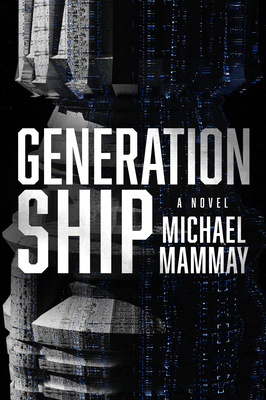
Blurb Book Review: Generation Ship by Michael Mammay (spoilers ahead)

Cover image from Goodreads.com

Blurb Book Review: Drunk on All Your Strange New Words by Eddie Robson (spoilers ahead)

Image by Goodreads.com

Blurb Book Review: Antimatter Blues by Edward Ashton (spoilers ahead)

Image from Goodreads.com

This novel is a sequel to Mickey7 and it holds up all right.

Mickey7 is back and this time he has to retrieve a bomb he hid at the end of the last book. The entire colony depends on the energy source inside the bomb to live through another winter, which raises the stakes nicely. Discovering the bomb isn’t in the hiding place also raises the stakes.

A life form native to the planet they’re colonizing has taken apart other colonizers to replicate the vocal construct of humans, which allows Speaker to, well, speak to Mickey7. Speaker knows where the bomb is and can take them there, but wants to form an alliance first because the entities with the bomb are enemies.

The plot is a bit thin and contrived, but the read was entertaining enough to get me through the book. I was annoyed with Mickey7 in several spots because of his dismissive attitude toward Speaker. I mean, here’s this life form who’s taking you on a trek to retrieve your life-killing bomb, but you aren’t going to respect him? Instead you’ll just handwave away his concerns? I suppose, though, that this means the characterization was consistent throughout.

Overall, this is a quick, light read that tied up the loose ends and left enough material for another book in the series.

Nitpick: the author seems to really like the term ‘to bear’ as in ‘bring the weapon to bear’. This was bothersome enough in the first novel and downright annoying in this one. Super nitpick: Speaker uses the term ‘to bear’ even though he’s never heard the term out loud.

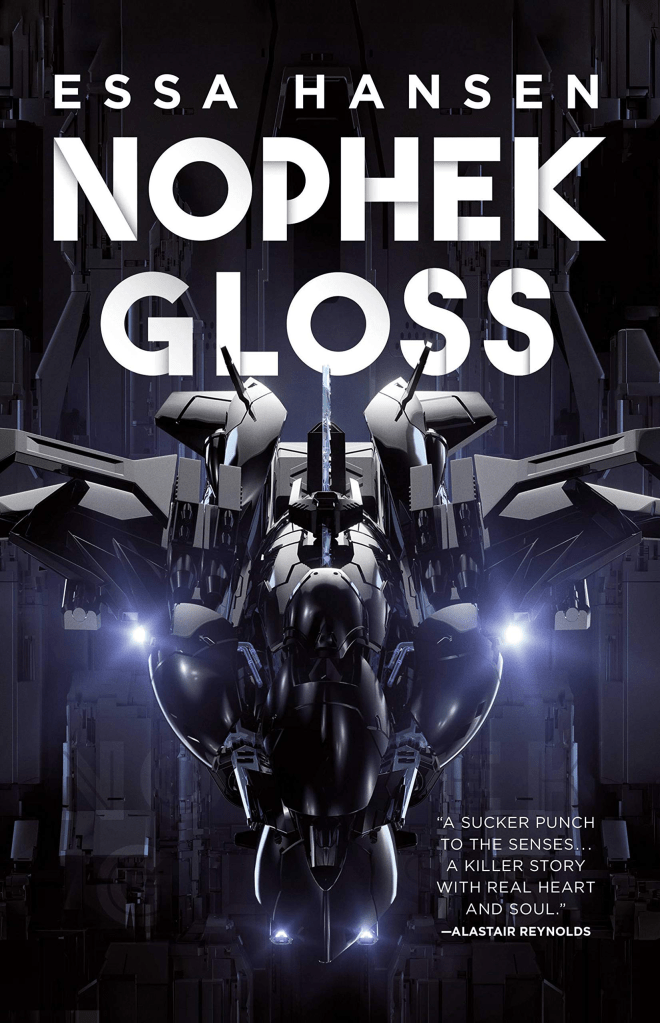
Blurb Book Review: Nophek Gloss by Essa Hansen (spoilers ahead)

Image from Goodreads.com

This novel has a high learning curve. There are words for things that don’t exist in our universe and while the definition of most of them can be gleaned from the context, some were harder to understand. Thankfully, the author put a glossary at the back.

The worldbuilding is fantastic. Describing ships that can pass through things, universes contained within bubbles surrounded by rinds, and wonderfully diverse species. The author uses descriptive language throughout that’s both immersive and a bit overwhelming.

The story is relatively simple: Caiden’s world is in ruin. His family cares for livestock, which have all died. The people are rounded up and placed on another planet, one with nophek beasts that attack and kill all the people. Caiden runs and hides in what turns out to be a ship. There, he’s found by a crew that helps him get off the planet and to the Cartographers, which help him see who he really is.

During this, Caiden learns he’s a slave. He decides to kill the slavers as revenge for what happened to his family – his people, really – but he’s only fourteen and nowhere near in control of his emotions. Caiden sets out on a difficult path, learning that he’s more than just a slave, and is put in an acceleration chamber where he ages six years and receives augmented body parts and knowledge.

The story is concise enough, albeit a bit coincidental in parts. The narrative voice is rich and interesting, but a bit overdone in parts. I wouldn’t trim anything down though, this book is meant to be dense and rich.

There’s a sequel, but I’m not sure if I’m interested yet. I liked where this novel ended and see little reason to continue reading anything except for the delight of immersing myself in the world. The story of the next book will likely focus on the relationship Caiden had with Leta, who also survived the norphek planet (I did warn you about spoilers). My problem here is that I’m not invested in their relationship and don’t really care how they’ll play off each other. The author was a bit heavy-handed with mentioning Leta throughout as some kind of touchstone for Caiden and after a short while I was trying not to skim the parts that mention Leta.

Also, I was a bit confused about Leta and Caiden. He’s fourteen and she’s ten, but the author wrote the relationship with romantic underpinnings. He calls her his sister, once he learns the word ‘sister’ and the meaning, but she feels more like a pre-lover, or puppy love, or something. Even then, I didn’t feel a connection to their relationship at all, so I’m not really interested in reading a whole novel of their betrayal to each other, as it’s set up at the end of this book.

If you’re looking for interesting worlds, species, and ships, this is a good read.

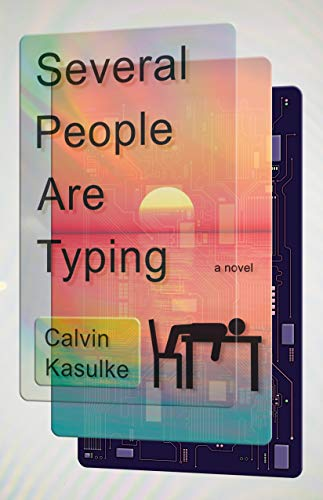
Blurb Book Review: Several People Are Typing by Calvin Kasulke (spoilers ahead)

Image from Goodreads.com

Gerald is looking at a spreadsheet when he gets sucked into Slack. It takes a while for him to convince his workplace friend to believe him, then go check on him. Even after Pradeep finds him, the rest of the office doesn’t really believe he’s in there. Instead they think this is just some elaborate overuse of the company’s new work from home policy.

While that’s happening, another coworker complains of constant howling. She goes missing and it’s like she was never there. Only one other person interacts with her so the question becomes, did she really exist?

Okay, this book is delightfully weird. The entire thing is written out as Slack conversations, including emoticons. The plot is simple and the execution interesting. This is a delightfully refreshing read.

Blurb Book Review: Mickey7 by Edward Ashton (spoilers ahead)

Image from Goodreads.com

Mikey Barnes is immortal. Well, sort of. He’s an Expendable, someone who is expected to perform the most dangerous jobs associated with colonizing a planet. When he dies, his body is put into the corpse hole where it’s broken down to its base components. Then another body is grown, complete with his consciousness.

This is Mickey’s seventh life.

During a mission he falls down a crevasse and into a possible lair of creepers – caterpillar-like entities that live underground – and is deemed unsalvageable. Except he’s rescued and when he gets back to his bunk he discovers Mickey8, the newest instantiation of himself.

The subject matter is what drove me to this novel. What an interesting idea, to have an Expendable on board to eat the local cuisine, breathe the air first, and even clean out radiation-thick areas of the ship. The author explained all of this well enough for me to simply handwave away a lot; like anti-matter engines and humans regularly going on one-way trips to colonize other planets.

I would consider this Sci-Fi Lite, if that’s a thing. There’s just enough science to explain things and the main focus is the lead character attempting to figure out how to live with a copy of himself, all while dealing with creepers, a hostile environment, and a ship crew that mostly see him as an abomination.

This is a fast read, with large font, easy sentences, and a tight plot. Some of the backstory dragged a bit, but was important enough to the overall plot line to keep it interesting. I found this novel to be a good example of how much science to include to keep the reader in the know, when and where to give backstory, and how to keep a lean plot.

Overall, I enjoyed this as a bit of science fiction fluff.

Blurb Book Review: Semiosis by Sue Burke (spoilers ahead)

Cover image from Goodreads.com

A group of people travel to another planet to live in harmony and peace. They encounter sentience in ways they hadn’t predicted.

The first generation of people live a hard life of eking out an existence on this new planet. One of the members of the second generation finds a settlement left by another species; a village of glass blocks and rainbow bamboo. The first generation people believe the bamboo – who provided delicious fruit – is trying to trap the humans there and argues against living in the settlement. A small battle ensues and many of the humans go to the village to begin a new life that includes less hardship and more time for pursuit of pleasure.

The bamboo is sentient and knows these new humans will provide gifts in terms of fertilizer (poop) and water. This information was garnered from moths that bit the humans and brought the little chunks back to the bamboo to analyze. The bamboo helps the humans by providing enzymes and nutrients that aren’t available otherwise. It also helps them with medical concerns and in return, the humans cultivate seeds of the bamboo and plant them where indicated.

The worldbuilding in the book is fascinating. I was engrossed throughout as the novel switched perspectives from humans to this bamboo. Both wanted to live a comfortable life and both assisted each other, sometimes reluctantly. The animals and plants were fantastic and richly described so that I was immersed in this new planet every step of the way.

The novel is told over seven generations. Each chapter is like a peek into a new generation or character and references events that happened off the page but are still relevant, like the computers failing and deaths from accidents. These references were a bit frustrating – I’d have liked to read about them – but I understood they’d make the book tediously long.

The conflict is gentle, for the most part. It’s the struggle of humans living with each other and dealing with differing opinions on important matters. One huge difference of opinion is tracking down the ones that originally made the settlement – the Glassmakers – and how to interact with them.

I almost didn’t want the book to end. I really enjoyed reading about the new creatures and how the humans dealt with petty squabbles amongst themselves, all on a colourful backdrop of a rainbow bamboo and glass village. I’d actually like to see this book made into a TV series.

Blurb Book Review: Upgrade by Blake Crouch (spoilers ahead)

Cover image from Goodreads.com

I’m just blasting through books! I have a stack of five more that I want to get read before they’re due back at the library.

I’ve read two other books by this author and I must admit, this one was easier to follow even though it was science-heavy. But easy to follow doesn’t necessarily mean good.

The novel is about upgrading human DNA to improve both physical and mental aspects. The narrator’s mother was a geneticist who tried to improve crops but ended up killing around 200 million people. Genetic engineering became outlawed and the narrator, Logan, is arrested for his part in the massacre. He serves time and gets hired by a government agency intent on locating anyone participating in gene editing.

When Logan is the victim in a bombing, his genes become altered via a virus. He becomes a kind of superhuman. The government captures him and observes him to track the extent of his changes. While the changes are setting in, a mysterious figure breaks him out. This mysterious person turns out to be his sister – also upgraded – who wants to follow in their mother’s footsteps and upgrade all of humanity. He believes he must stop her at any cost.

I had no connection with the main character. I didn’t care about him at all, which made it hard to care about the story. I also found the author’s style to be a bit distracting. This novel was definitely easier to follow but I had a sense of general misogynic threads. As an example, Logan was seeing a psychologist named Aimee. Not “Dr. –“, but Aimee. Also, Logan’s wife, for no reason at all, gets into a bathtub with Logan while he’s in pain from the upgrade. Why would she do that except to have the reader imagine her naked? A regular bathtub barely fits two people, which made this whole scene just a bit distasteful.

The author also used nouns as verbs. The character ‘glassed’ the area (looked through binoculars), and ‘badged’ in (used a security badge to electronically open a door), and ‘broomed’ the area (swept it). While I can accept these, they did pull me out of the story a bit.

Overall, it was entertaining enough to finish. I was curious about how Logan would save the world, but I admit I rolled my eyes at the solution. While it was good, it was also a bit hokey.

Blurb Book Review: City of Orange by David Yoon (spoilers ahead)

Cover image from Goodreads.com

This book left me thinking about loneliness, being alone, and survival.

Adam wakes up in some sand surrounded by cement, with a head injury and no idea who he is, where he is, or what’s happened to civilization. He finds a strange key in his shoe and a bottle of pain relievers in his pocket.

Assuming the world has ended somehow and that he’d been attacked by someone, he begins to figure out how to survive until he can remember things. He finds a few tools in the flotsam of the dried up river and a faucet with running water. After a short time he also finds someone’s shelter under a bridge. Inside the shelter is a camping stove, matches, and some canned food.

Anything that brings memory back is pushed away. Can labels are removed and he pulls himself out of memory as quickly as possible. He knows that whatever is lurking in his head is bad and he’s just not ready to face it yet.

While surviving, he encounters a young boy, Clay, who becomes a sort of friend while Adam tries to navigate this new world.

What got me was how Adam was alone and nobody seemed to be looking for him. He had no phone and no thoughts of one, except that they were things people had Before. Before what? The reader isn’t told until near the end.

Everything is explained, slowly, in little bits, in a way that satisfied my curiosity.

This novel made me think of our online world and how if we simply stop posting something, we just disappear. If we have no contacts in real life, our disappearance is barely noted. Some may wonder where we are or what happened, but our attention is quickly taken away by some other tidbit of information swirling around us.

It also made me think of how alone we are even when surrounded by people. Sometimes an event will shatter our world and even though we’re reeling, others are carrying on with the mundanity of life.

Excellent book, highly recommend it.

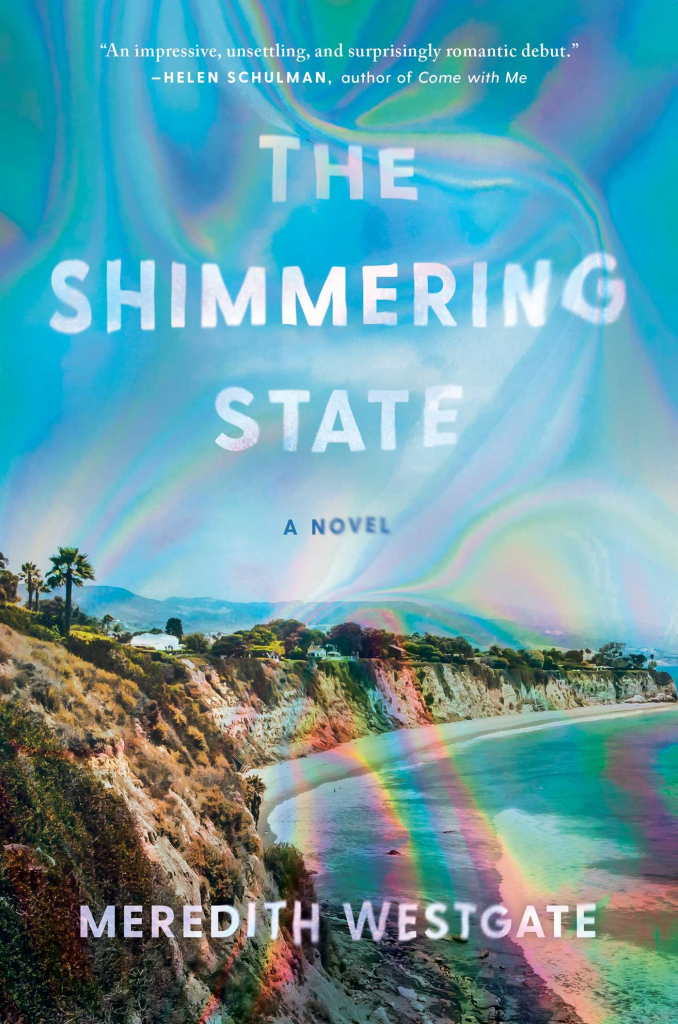
Blurb Book Review: The Shimmering State by Meredith Westgate (spoilers ahead)


Book cover image from Goodreads.com

This story takes place in a world where memories can be extracted and put into pill form, called Memoroxin. These pills can be consumed by people and they’ll experience those memories as if they were their own. This process becomes part of a new medical therapy for Alzheimer’s patients, where they can experience their own memories in hopes of repairing the mind or at least staving off the disease for a while.

The pills are also used recreationally by others.

At no point in the narrative did I read that consent was given by the memory’s owner to be shared. The implication could be that people voluntarily sold their Memoroxin pills for money, but other than that, each consumption of the pill, when it was someone else’s memory, was without consent.

On to the characters.

Lucien moves to Los Angeles to be with his grandmother while she undergoes this treatment for Alzheimer’s. His mother died of cancer very recently and he’s still raw with the loss of her.

Sophie moved to Los Angeles to advance in ballet. She got the lead in a production, La Sylphide.

Dr. Sloane runs a rehab clinic for people who have become addicted to Memoroxin, as well as heads up the research for Alzheimer’s patients.

Lucien sees his grandmother’s pills and yearns to feel closer to his mother. He steals a few of the pills and consumes them, learning about a secret his grandmother had as well as how much love his grandmother had for him and his mother. When his grandmother dies he takes the remainder of the pills all at once.

The novel opens with Lucien entering a rehab facility and agonizing over a secret baby. From this intro, I thought the novel would be about revealing the secret and the consequences of that action. Spoiler alert: it wasn’t. The secret is revealed to the reader, but the information goes nowhere. Lucien doesn’t use it for anything other than to feel closer to his grandmother.

Sophie works as a waitress while not training for her performance. There, she sees others spaced out on Mem. She also spies a particularly distasteful man, Ray, who is a mover and shaker in Hollywood. He regularly uses Mem and encourages young actors to do the same. Sophie doesn’t like him, she merely tolerates him.

Her personality is somewhat irksome to me, but I’ll admit she’s a well written character. She’s anxious and is the kind of person that goes along to get along. At one point, Ray corners her into accepting a drink with him.

She knows he takes Mem. She knows he forces it on others. Yet she accepts a drink with him rather than have him mad at her. After all, he can make one single phone call and she’ll never work as a waitress again. This bothered me so much. There are plenty of restaurants in Hollywood and what, he could ruin her chances at earning minimum wage plus tips? This storyline felt weak.

Anyway, she accepts the drink and, surprise surprise, it’s laced with Mem. The memories she ingests are violent cravings for injuring people. These violent tendencies linger after the Mem wears off, enough that she seeks out more Mem and cannabis to numb herself. She spirals out of control and ends up in the rehab facility run by Dr. Sloane.

Dr. Sloane is barely more than a secondary character, but it’s worth noting that while she and her partner developed these pills, she ingested some of her partner’s memories. She saw herself, unflatteringly, through her partner’s eyes. At her rehab facility she treats a man named David, who turns out to be her daughter’s boyfriend.

During treatment, the patient is given a pill bottle full of their own memories. They take them in a controlled setting to help heal traumas and even erase disturbing memories.

Dr. Sloane’s daughter, Remy, takes David’s pills as a way of remembering him. Dr. Sloane finds out by accident, just before Remy is hit by a car. Brain damage results and Remy is taken to the rehab center as the facility deals with memory loss and brain injury. Dr. Sloane takes it upon herself to remove all of Remy’s memories of David under the guise of protecting her daughter.

Then Dr. Sloane takes her daughter’s pills, the ones with the memories of David. The author writes that Dr. Sloane feels like she understands her daughter more as a result, and even knows that this action is a violation.

I almost threw the book at the wall.

So the doctor, who took the pills without her partner knowing, also takes her daughter’s memories away and consumes them for herself and is somehow supposed to be sympathetic to the reader? No.

The other two characters, Lucien and Sophie, fall in love at the facility. When they leave, their memories of the facility are erased. They find each other anyway afterwards and start to fall in love again.

I could have been satisfied there. If this book is considered a love story, well the circle is complete, the couple is together.

But the author ties up one more thread.

Sophie goes to the restaurant/bar where Ray is hanging out. She’d selected one of her post-therapy pills that was thick with her disgust for this man, her and her coworkers’ contempt for him, and her overall loathing for him. She crushes the pills and slips them into his drink.

So, she was violated by being drugged with horrible memories and her reaction is to violate him with distasteful memories. The author gives the impression that Sophie is proud of herself, that Ray will feel these awful feelings and they will impact him in the same way the violent memories impacted her.

But they won’t. Why? Because of the person Ray was. He’s the kind of person who doesn’t care what a bunch of waitresses think of him. Their opinions are beneath him. I’m sure he’d feel awful for a moment or two, then shrug it off as ‘a bunch of bitches’ or some such thing.

That ending left a foul taste in my mouth. Revenge is never a good answer. While in this novel you can make a person feel what you feel by ingesting their memories, you can’t forever change their outlook on life based on that dose. How a person reacts to feelings, emotions, and memories is just as important as feeling something someone else feels.

Anyway, the narrative style was rich with imagery while also feeling like the author was telling me the story. An odd combination that frustrated me throughout. The concept was interesting though. Extracting memories and consuming them is fascinating.

I really didn’t like lack of consent throughout though.