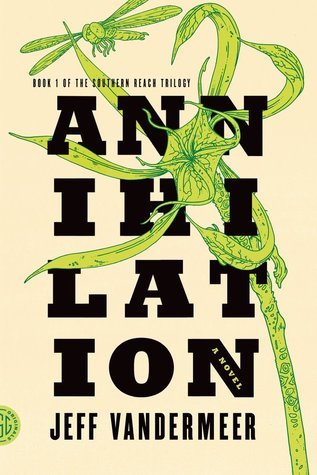
Four women; a biologist (the narrator), a psychologist, an anthropologist, and a surveyor, are sent into Area X as the twelfth expedition team. Their purpose is to map the area and make observations, all while trying not to be affected by the area itself. The biologist volunteered because her husband was part of the eleventh expedition.
The narrator gets infected very early on by inhaling spores and tries to cover it up. While she continues the investigation she learns that the psychologist is hypnotizing the three of them, that there had been more than eleven expedition teams before them, and that there’s some kind of life form deep underground.
While this novel was good, it felt incomplete. It’s the first in a trilogy, which might explain why the story is left dangling. The biologist is the only survivor of the expedition and she chooses not to return to the border, but instead to follow in her husband’s footsteps.
I found the dangling storyline frustrating. I wanted to know what the alien was, why it was there, when did it arrive, is it actually an alien, how drastically the biologist changes, and how those changes affected her. Maybe those answers are in the next few books.
In the story, the biologist encounters a massive pile of journals but doesn’t inform the reader of what she’s read, which is a pet peeve of mine. I wanted to know what was in those journals, how far back did they go, how many different people wrote in them, and why they were in a huge pile. I understand that this narrator is unreliable, but still, this was frustrating.
Overall the novel was good, it was an interesting peek into a mysterious zone, but irritatingly incomplete.
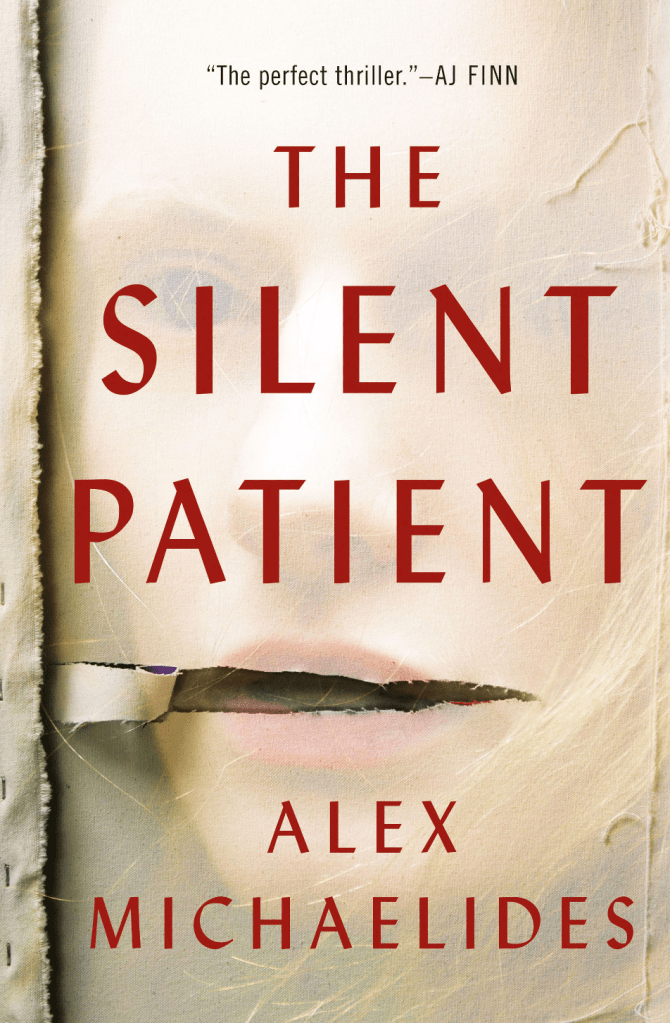
Alicia is an artist married to a photographer. On the surface, they have a great life together. That is, until Alicia is found standing next to her husband, who had been shot five times in the face. She refuses to speak from that point forward and is sent to a psychiatric facility in lieu of jail time.
Theo is a criminal psychotherapist who is overly interested in Alicia’s case. When a position at the facility opens up, Theo jumps on it in hopes of treating Alicia. His treatment is mostly successful. Alicia attacks him at first, but eventually opens up enough to talk. But what comes out of her mouth is lies.
The novel is told in flashbacks through Alicia’s diary and through the eyes of Theo. As a reader, I felt there was something off about Theo’s interest in her and his pushing to treat her. It turns out he’s an unreliable narrator, which the author pulls of brilliantly.
The twist near the end had me gasping out loud. Truly fantastic. I think I should have seen it coming but rather than try to predict what would happen I simply let myself get carried away with the story.
One nitpick is the author’s heavy references to Alcestis, the heroine of a Greek myth. While it’s relevant to the story, I grew weary of the references early on.
I bought this book because my library is still closed. Don’t get me wrong, I want it to be closed because of a tiny virus making a big impact on the world, but I do prefer to borrow a book rather than buy it. I rarely read a book twice and just about never read it more than twice, so buying them seems a bit wasteful. Except they fill shelves and it’s nice to have a physical reminder of the words I’ve consumed, I suppose.
Anyway, I was glad I bought this one because I might like to read it again, now that I know how it ends. I suspect this book will reveal things to me that I didn’t see during the first read, and that I’d understand better now that I know the ending.
Forewarning to readers: this book was a bit disturbing.
The Gloss: This is a little book. Smaller than a trade paperback, larger than a pocketbook, and only 213 pages. The pages are soft, the typeface (thankfully) sharp and clear. Pleasant to hold and easy to read.
The cover is made of that nice, slightly rubberized stuff that’s popular right now. It makes the book feel like my fingers can grip it easily and without sending my fingertips into sensory overload.
There’s a fracture in the title. Nice and subtle, but there nonetheless. This is an excellent representation of the main character’s fractured personality. Not too broken, just slightly, uncomfortably, off. Well done.
I also like the image of the kinked hose. From my perspective, that image reminds me of one of the minor annoyances of life. I mean, has anyone else felt that grumbling irritation of having to unkink a hose? In addition, the kink indicates a pressure buildup, but one that’s contained. There will be no explosion, no debris scattered everywhere, just a rush of water the instant that the line is free.
The Characters: Thomas is the main character and the book is entirely from his perspective. He’s detailing his past to the reader, explaining why he did what he did, how he arrived at one particular decision.
Miriam is Thomas’ wife, Ava his daughter. Both are presented entirely as Thomas remembers them. The author maintains this perspective throughout, enough so that it’s a bit frustrating as the reader. I wanted to know things from Miriam’s pov, or even Ava’s, but I also know that additional perspective would’ve tainted the story.
There are other, tertiary characters, like his mom and sisters. The mention of his dad, but not too much. Instead, the author demonstrated the impact the father had on Thomas without Thomas saying too much about him. Enough to know that the father was abusive to the children, and that Thomas had a few of the more unpleasant traits like controlling behaviour and narcissism.
Readers do get a glimpse of Thomas in how other characters react to him. Or, more accurately, how he remembers people reacting to him. One scene describes Miriam talking to a group of people, how easy and relaxed she looked, until she saw him. Then she flinched hard as if struck. Thomas waves this away, makes excuses for what someone else might think is a hint of abusive tendencies.
The Plot: Simple and elegant. No extraneous plot lines, no plot points left without explanation.
Thomas has everything: prestigious job at an advertising firm in Manhattan, wife and daughter, and is a devoted family man. His ego is rocked and he does something horrible that he can never undo. The book details his introspection leading up to the pivotal event.
The Story: Beautifully told with rich language. Tidbits of foreshadowing are doled out just often enough to add a sense of foreboding. As a reader I was never rushed to learn something, nor ever left wondering where the tidbit led.
Thomas goes back and forth in time during his introspection but the reader is never left wondering when he’s talking about, nor are the transitions sudden or difficult.
Nitpicks: I didn’t have any. Nothing stood out as annoying or out of place. The only thing would be the near constant opera references, but those serve to highlight how Thomas views himself, so they have a solid purpose. They were abundant though, and for someone like me who knows absolutely nothing about opera, the author gave enough information that I wasn’t frustrated by the references.
Quick edit: The book has no quotation marks for dialogue. While this can be confusing, it fit well with the formatting of the story. Also, quotes weren’t required as Thomas was relating the dialogue to the reader, rather than have the characters speak for themselves, which also reflected the story well.
Overall: This book is excellent. Early on I had the sense that Thomas was an unreliable narrator, that perhaps the image he was presenting was false, but it was subtly done. Enough so that I could identify with him on several occasions, and felt bad for him.
I loved the language used, the way the author describes everything. Ani Katz is an author I’d read again regardless of content.

 Should Be Writing